Why I choose the unknown over the comfortable failure
And I thought, ‘Giving up isn’t getting me anywhere at all.’ And that would be another failure. Well known, comfortable, relaxing.
That is the part worth looking at. Failure is a known quantity. You already know the shape of it, the cost of it, and the way it feels when it arrives - and it closes the question. The unknown does not close anything.
Giving when full vs giving when empty
I gave myself a rule somewhere along the way, and it is the one I never had to negotiate with myself about. I do not quit while I still have something to give.
There is a difference between giving up when you are full and giving up when you are empty. The first one is a decision, and a good one - you are choosing from a position of energy, and you can still see what you are choosing. The second one is not a decision at all. It is a fact of how much is left in the tank. You did not quit. You ran out.
The relief feels identical in both cases. That is the trap.
When I started this blog, I had no idea what I was doing. Later on, when I had lots of time, it became natural to sit in front of my iPad and focus on one topic that came to my mind. Now, when days are busy with a full-time job and the rest of the tasks, there is much less energy and time. Lack of results leads to skipping the routine. It then easily slips out of the focus.
But slipping is not quitting. It is a routine that lost its fuel - and the answer to that is not to abandon the routine, it is to put more energy into it while there is still something to give.
The unknown challenge
It was today when I found a simple yet powerful truth: it’s more comfortable to fail than to keep acting through the unknown.
There is a reason for that, and the reason is not weakness. A known outcome is predictable - you can plan for it, budget for it, and stop thinking about it. An open question keeps producing options, and options are what make the next decision better than the last one.
So the uncomfortable choice is the one that buys optionality. I am not choosing the unknown because it is easier. It is strictly harder, and it stays harder. I am choosing it because every closed question takes one option off the table for good.
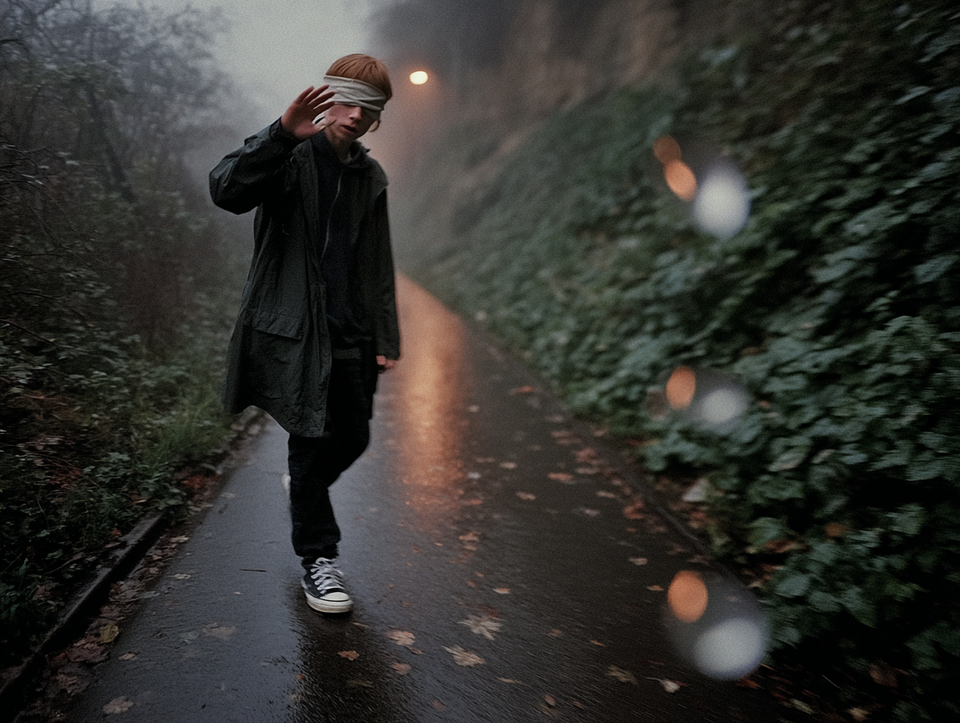
Last year, I was challenging myself by closing my eyes while walking. Obviously, I wasn‘t doing that on busy street, and I’m not suggesting doing so. However, I thought that was quite similar to what I was doing.
My best results were 23 steps until I started panicking and opened my eyes. Sometimes I was a bit to the right or left from the initial trajectory. But I still hadn’t hit any tree, fallen, or otherwise harmed myself. I was investigating how a lack of clarity (vision in this case) affects me and how long I can handle it.
After around 15 steps each subsequent step feels incredibly hard and scary! It feels like I‘m lost. No control and understanding, and imagining I’m going to fall down into a ditch in the very next second. Nothing in the darkness changed though - what changed was that I stopped being able to feel the next step.
It’s not enough to learn how to walk
The experiment I described above taught me how important it is to see at least one step ahead. It is not so comfortable, but still doable, to walk at night with very limited sight versus no visibility at all.
A lack of clarity is not the same as a lack of direction. You can walk a long way with limited sight. The one thing you cannot do is walk blind with no sense of the next step - not the whole path, the next step.
Most people quit at the moment they lose the next step, not the moment they lose the path. From the inside those two feel exactly the same - both feel like ‘I don’t know what to do’ - but only one of them is a problem you can solve, and the other is a decision you have already made without noticing.
Being able to take a step is just half of success. Knowing where to step is the other half.