A metacognition skill
and why it’s important in the era of AI.
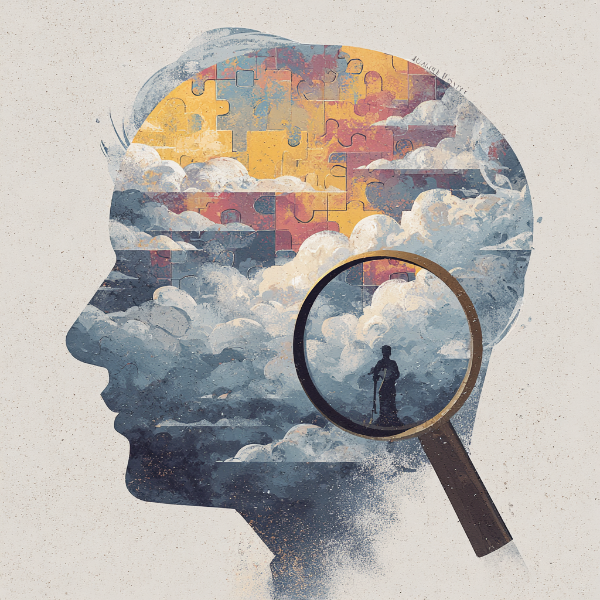
Since I remember myself I was always questioning things. Mostly silently, but acknowledging and gathering tips and details. Exactly like people are building a puzzle - I was building my understanding of the world. And endlessly questioning: what’s wrong with you, guys?
Recently I learned about metacognition - a skill or “brain mode” that is explained as “thinking about the thinking”. It is rare, hard to develop and extremely useful. If used right. I am lucky to have this, yet I paid my price for it. It’s not a solution for everything and it’s definitely not making me happier. But it helps me moving forward.
Why it’s a special skill?
Let’s start straight. I have no idea how people are living without this skill. I either don’t remember when things were happening differently or it never happened differently. Nevertheless - the process of analyzing thoughts, actions and, lately, feeling - is going in loops.
It’s a special skill because it allows to see myself aside. Not “me doing”. Because we naturally treat “me” and “my” completely differently. And it’s easy to spot external problems rather than inner problems.
And the difference is huge. As soon it becomes personal - ego and psyche does everything to protect us. Last few months I’ve been reading about narcissism. And that’s a disease that shows full power of our psyche to protect fragile ego. Layers of filters, tricky scenarios and marvelous play - all these to avoid shame. This is considered as toxic behavior and it is so, because it’s harming others. Especially those unprotected, leaving scars and - forming traumatic filters. So strong people may never self-discover these.
An example of harmful behavior, on the other hand, shows us how powerful our filter could be. And it seems metacognition and the right approach allows us to recalibrate, adjust the exact same mechanism to become “better”. Let’s reserve “better” for separate topic and consideration, though.
It’s more important now than ever
We don’t know how brains are working and processing information. Neurons, links etc. But what happens exactly? How we are thinking? How thoughts appears and dissolves? There are theories more or less official on this. But full explanation is not available.
Now, everyone’s obsessed with AI - Large Language Models that are operating as blackbox. And nobody is able to explain how and why results are what these are. I have my own mental model I am not ready to share yet. But there is one think I understand well.
The context matters
Years of observing my own brains taught me how it works. At least from practical perspective. I know conversation might light a spark and I can see many directions where conversation might land. And it’s not easy to choose which one I want to go. When I learned about metacognition - I was surprised that’s not the way how other people are thinking. But cutting to the chase.
Longer conversation means more decisions I have to make where to lead this conversation. More options to choose. Context of the conversation is growing. Without maintaining connection with the reality - a script, a plan or someone I’m talking to at this moment - it’s getting bloated and derailed.
I think this is pretty straightforward now. This is exactly what happens to LLMs with the growth of the context. I don’t have formula or metric for this - but again, I have years ob observation how my brain works. Despite LLMs are not exact copies of our brain - my observations are these are working pretty similarly.
Conclusions
If I want to give you something useful in this article it is this: “divide et impera”. This is a golden rule that built empires, software, civilization. If you’re bloating AI with all you have - you’re demonstrating mental laziness and inability to make decisions. Our brains and LLMs we’ve built are great, when these are focused on solving specific problem. Structuring the problem - is a specific problem.
Conclusion #1: we don’t need bigger model/context. We need better cooperation.
Metacognition is not a path to happiness. It might sound cool. But the price I paid comes with a lot of pain and unhealthy relationships.
Conclusion #2: sometimes it is better to not understand things. Seeing own dynamics opens a power of seeing others. People aren’t the best creatures. Sometimes they might seem to be the worst living on the Earth. Dealing with that requires huge patience and love.