The Builder Layer - Part 2: DECIDE
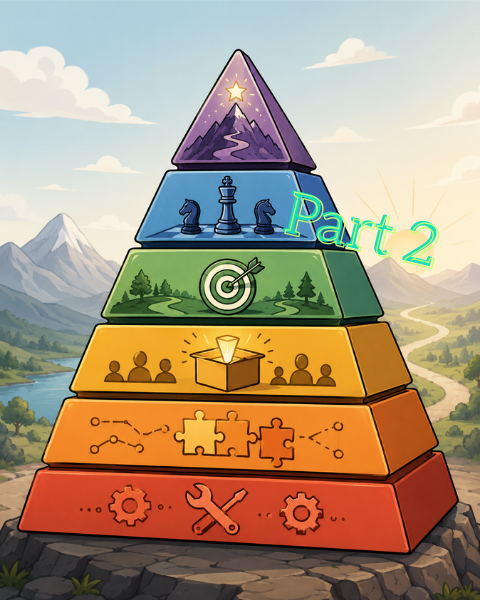
The Layers
The first 3 layers determine whether we can build something correctly.
 Eli Lap
The next 3 determine whether it deserves to be built at all.
Today's post covers Layers 4 - 6, which I initially thought of as the "thinking" layers. It required some distance to define them more precisely. Thinking is valuable, but is rarely enough. Since its main goal is to address "doing the right thing" problem, this becomes the "decide" level. Decisions are actionable, while thinking is not. No matter how deep, wide or intense thinking was - if you share your thinking in form of a vision or direction in a crowded room - everyone will leave with their own version.
Decisions always have a name beneath them: a person, who can explain them, provide details, align teams and reduce misinterpretation.
In the era of AI these layers are much more sensitive to AI hallucinations. Without supervision brilliant ideas become average, stupid, sometimes harmful. What I am trying to say here is to warn you about outsourcing the decisions. You may research, summarize, introduce, share whatever materials LLMs will prepare for you. Please make sure you made the decisions or at least you are aware of the specific decisions and understand consequences of it. AI can be helpful in researching those as well.
This way layers 1-6 are completing and extending each other, providing a comprehensive framework, that addresses oversimplified "do the right thing the right way".
4. Product Design layer
If Henry Ford had asked people what they want, they might have answered, "A faster horse"!
The Product Design layer is where technology largely stops being the constraint. Technology matters here mainly through its limitations: some solutions are impossible, while others are simply too expensive. What matters on this layer are problems. Problems people want to be solved and people are happy to pay money for.
And the biggest challenge is: people are not aware themselves what do they need. Asking for a faster horse is completely misleading when we now we have to build a motorized vehicle. That's the reason it's a perfect example. We don't know what we are solving, people don't know how to solve their problems, so how do we build a product out of it?
Product design requires us to understand the underlying problems. This is only achievable when the problems are discovered. Not assumed, not made up. Real people, real problems, ignoring the solutions, getting deeper until problem or pain is revealed.
This is the place where AI becomes helpful, but AI has less chance of taking over the entire process. It can emulate but can't express real empathy. Lack of empathy will cause lack of trust, therefore real problems may never be discovered. The goal is not to hear the magic words, "I think the problem is ...", but actually understanding the meaning, the flow, the context.
An umbrella might be a great solution to avoid getting wet in the rain. Until you're traveling by bicycle or motorcycle. Suddenly, the umbrella introduces new problems, while solves none. The context is almost the same, except they are on the move. It's enough for umbrella to lose any value. A solution is not valuable merely because it addresses a problem in isolation. It is valuable only when it improves user's complete situation.
Even after trust is built and pain and problems are revealed, there is an important job to do. Decide which pain and which problems are worth solving. And this is something that belongs to humans. Sometimes it's mix of gut feelings and previous failures that suggest the right way. AI can recommend a decision. It cannot care which decision is made, take responsibility for it, or live with its consequences.
5. Strategy Layer
I was over 35 when I finally understood what it means to make a decision. It means one thing: saying no. You can accumulate an unlimited amount of yeses, creating a bloated project, an overworked team, and a trail of implicit and unconscious decisions that makes the project worse month after month.
"No" doesn't work that way. Using "no" for absolutely anything leads to a state when there is nothing to build. Imagine, if everything is rejected - there is nothing to act on. That's the path to unlimited possibilities and unlimited achievements, because 100% of resources are available. However, such a state is also a nonsense. Therefore to successfully utilize this approach we have to learn which ideas are not good enough to receive "yes". If there are 8 out of 10 ideas being rejected - there are still 2 that are worth to be worked on.
Strategy is not saying no to everything. It is deciding which ideas are good enough to deserve a yes.
Once the "no" job is done properly - it defines the unique path. It does not provide meaningful recipe for decisions what to say "no" to. But it protects the resources, ability to move, pivot if needed, and keep going forward. It protects peace of the people involved. It provides clarity. It builds authenticity.
While "yes" creates commitment - "no" preserves optionality, acting as a guard for limited resources which are time, attention and money.
I don't even want to try to make up examples of how low-quality AI decisions are on this layer. The only thing it might do here is to provide a structure for handling the strategic decisions or make up some examples from successful stories. While structure might be useful - reimplementing someone's strategy won't lead anywhere. Copying someone else's strategy does not give you their context, timing, capabilities, or reasons for choosing it.
6. Purpose layer
I called this a layer and in reality that's also a core that keeps all the layers together. Each layer is affected by the purpose. Each layer falls back on the purpose. Each decision is related to the purpose. Each "no" is explained by the purpose.
Purpose layer ends discussions before these even started. It can even reduce decisions in batches on the Strategy and Product Design levels.
Purpose layers reflects the values.
Why do we do what we do?
Where are we going?
Sounds abstract, philosophical, vague. Nevertheless these questions are worth to be answered. The biggest challenge is to avoid hypocrisy. "We want to help humanity" has become one of the easiest statements to write. And one of the hardest to believe.
Every commercial organisation must eventually produce enough economic value to sustain itself. Pretending that money is irrelevant does not make a purpose more noble. It only makes it incomplete. So why it's not the part of a purpose? Because it might be misunderstood. Because not everyone is feeling ok with "making money" being their goal. Because it is going to raise too many problems. So this is avoided at all costs. Even it is natural to have a mix of both "making money by helping people eating better". This is real.
What can AI do here? Well, it can mask all insecurities and problems and hard questions, making documents that looks amazing. And these amazing documents are belonging to Sci-Fi book.
What to do better? Use AI to reflect. What matters? What's missing in perspective I'm following? Are there other similar purposes? Which philosophy my purpose is related to?
This becomes a never ending journey, requiring self-actualisation. Not on a daily basis, but maybe a few year or a cadence.
Closing: The Layers
The layers do not guarantee anything. These describe a mental model: a set of blocks that can help us think about real problems in a structured way. It isn't new, it isn't directly copied from anywhere. These layers and explanation comes from my own experience, reflections, knowledge I managed to gather through the years from various environments. It was shaped mostly by my experience with software engineering teams, which face fewer physical constraints than hardware-focused teams.
And it taught me freedom comes at a cost. A cost of making decisions. And I've seen too many teams fighting windmills because of the wrong decisions.
We've been outsourcing decisions to other humans for centuries. Delegation can work, but surrendering judgment and responsibility rarely does. Now, we are placing the same hopes in machines. If it failed with humans I see no way it may work with machines.
The ability to decide cannot be separated from the responsibility to live with the consequences.
I can say that from experience. I spent most of my life making purely calculated decisions while ignoring my feelings. This is a miserable life. It is safe and it takes away the joy of living. Meeting the expectations, being even a better average gets you nowhere. Be you. Let your team know who you are. Let them be them.
I started at a point where I was silent about it, providing some feedback when asked. I went through the point being explicit about the organisational problems till the point, when I decided to pay the cost of seeing and knowing. The cost is brutal - I have to make decisions for myself, whether I want to support specific environments. Quitting wrong environments is not something I do to punish somebody, but I do it for me. And to return responsibility to those who are in charge. Because lifting and handling someone else's problems forever is toxic and unfair.
I believe this framework can help talented engineers and managers avoid preventable mistakes and focus on improving real systems instead of blindly competing with machines that operate a thousand times faster than we do.
Used well, AI can widen our perspective and increase what we are capable of building. Used poorly, it can multiply decisions nobody fully understands and nobody wants to own.
Execution is becoming cheaper. Responsibility is not.
Even an unconscious decision has a name attached to it.