AI Agent Can Execute. You Still Have to Think.
A month ago I noticed OpenClaw (OC) stated they were releasing OpenClaw 2. At the same time an upgrade messages suggested a pretty regular 2026.7 to 2026.8 upgrade. I prompted the OC agent for the details and made an attempt to upgrade. It ended up as one of the worst experiences of maintaining software I’ve had in a few years. I got stuck with error messages that had nothing useful except suggesting using openclaw doctor, which could not solve the problems.
Initially, I approached the migration in an old-fashioned manual manner, using LLMs for finding directions rather than agents to do all the heavy lifting. I purposely wanted to learn more about the changes. I made one basic mistake. I had to treat it as a big migration, prepare a testing environment, and not touch the production server on my first attempt.
When I ended up with a harness that couldn’t fix itself and was running out of time, luckily I was able to roll back and restore the functionality. And I left it for another month, until last weekend when I had enough time and determination to take it to the end.
Should I experiment before making changes?
I was considering running a copy of the VM to experiment. At the same time, I wanted to avoid unnecessary activities. These would be caused not by having two environments. Working with a test environment would make me less careful, as the stakes would be lower. But experimenting and executing is something agents can do well enough and much faster. The modern world has different challenges for us. Therefore, I decided to take a different path. Execute and train my judgment, skipping the experiments.
Backups are a must — therefore, I did them on multiple layers. Just to be sure I had a way to roll back and have my agents working again. But even before I did the entire backup cycle, I asked the agent to do self-diagnostics and come up with a plan. A plan that prepares us for a migration.
It turned out previous migrations left some configs and records dangling around. Understanding the actual state and a safe way to clean it up took most of the day. Agents were helpful, but often derailing and misinterpreting the actual state.
Building a pre-migration skill
Since agents were losing the understanding, I knew that my tactics made sense. Understanding the harness, its structure, memory, and storage is a must for further changes. But knowing the actual state is not enough. It is important to learn the difference to predict upcoming issues. To guide agents to double-check and do as much as possible before the harness becomes unresponsive. I already knew it would because of the previous attempt.
Instead of having a conversation that would include endless back-and-forth rounds, I decided to compose a reusable skill. From the previous experience, I knew which areas were failing for this specific upgrade, and the same areas seemed to be critical for restoring basic functionality. This way, I created a dedicated checking-openclaw-upgrade skill.
 AsperAdAstra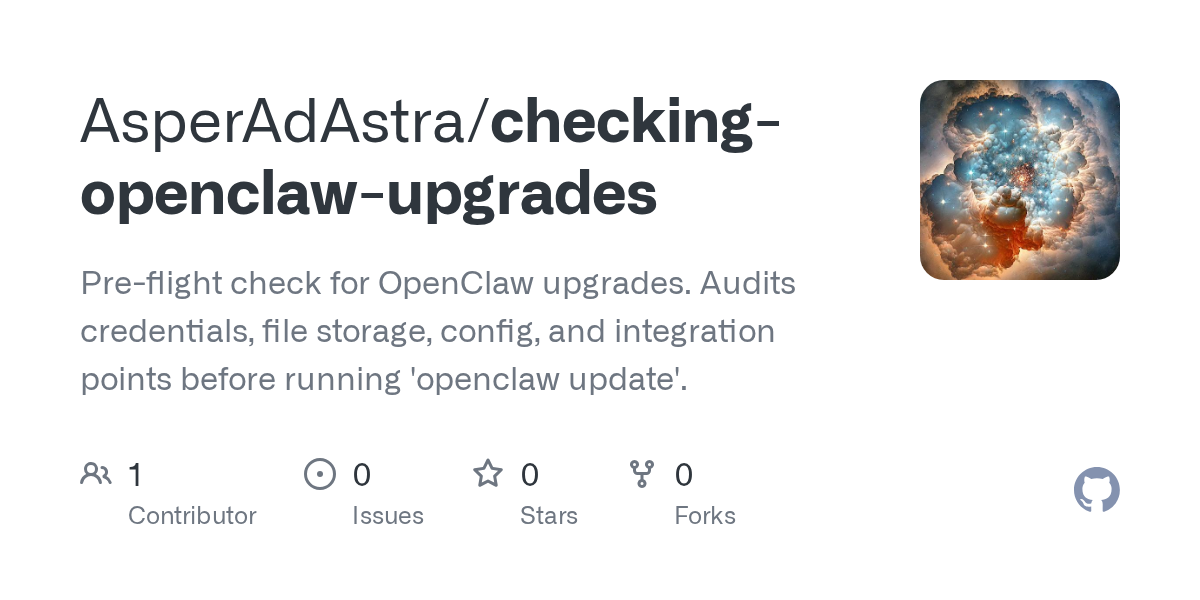
This way, the agent compares the current state, upcoming changes, and reports back — what to fix, what can be improved, and what shall happen. This mostly looked like a migration plan, not a random upgrade execution following a hope-driven development approach.
The preparations don’t solve all the problems
Despite weak areas being improved, clean-up being done, and a migration plan with risk assessment being present, OpenClaw ended up in an unusable state right after migration. This time, instead of going through the wall of errors, I asked Codex to fix it. I must confess, GPT-6 Astra did it mostly on its own. Yet this time I was able to follow it and understand which direction it was taking. It gave me confidence in success because I knew I was able to step in and adjust things manually.
While the subtitle may be read as “preparations make no sense,” that’s not the lesson here. The main point is that we still have to watch closely what happens. We still have to guide agents in the right direction and make decisions. Most of it seems easy until you see how it punches you in the face after 5, 10, 50 iterations. That’s what we need experience for. To have judgment and the ability to make better decisions.
Agents powered by LLMs can be extremely fast actors and remind me of the good old Solver from MS Excel. They are much smarter and more capable. Yet they attack a problem brutally straightforwardly. Sometimes pivoting successfully, while in other cases missing a completely simple and straightforward solution.
“Yes, you’re right. I can’t close the door to your room. I don’t have physical body.” Don't make AI confident promises to alter your reality.